2017 AGM
WRNS BT Annual General Meeting 5th May 2017
The 75th Annual General Meeting of the WRNS Benevolent Trust was held at The Royal Navy Fleet Air Arm Museum, Yeovil on 5th May 2017.
In the presence of
HRH The Princess Royal
Patron, Women’s Royal Naval Service Benevolent Trust
Opening Remarks
The Chairman, Cdr Andrea Crook RN, opened the meeting by welcoming Her Royal Highness The Princess Royal, a Deputy Lieutenant of Somerset, Vice Presidents and Trust Officials, Guests and Members, to the Seventy Fifth Annual General Meeting of the WRNS Benevolent Trust. She said that 2017 marked the centenary of the formation of the WRNS and that it was a privilege for the AGM to be held at the Swordfish Centre; she thanked the General Manager of the Fleet Air Arm Museum, Mr Marc Farrance, and the Executive Officer of RNAS Yeovilton, Cdr Barrie O’Sullivan RN, for their support in making this event possible.
Cdr Crook said that Cmdt Elizabeth Dunlop (nee Craig McFeeley) had hoped to attend the AGM but, having very recently reached her 90th birthday she had very reluctantly advised that she was unable to attend.
Sadly, on Tuesday of this week, the Trust had learnt of the death of one of its Vice Presidents, Mrs Mary Brown OBE. Mrs Brown had joined the WRNS in 1942 and was one of the first 9 Wrens to qualify in Ordnance. She served at HMS MIDGE (the Coastal Forces base at Great Yarmouth) until 1945, and then undertook a short posting in Sydney, Australia before leaving the service in 1946. She had been elected as a Governor of the Trust in 1987, and served as Chairman from 1991 until 1995. Mrs Brown also served as Chairman of the Association of Wrens in the 1980s. She had been a longstanding supporter of both charities, and would be very sadly missed. Her family had requested representation from the WRNS at the funeral and details would be available from the Trust’s General Secretary in due course.
Also, in January of this year, the Trust had learnt of the death of Miss Penny Wright, who served in the WRNS from 1958 until 1969, before joining EMI/Thales, where she had worked on the Eurofighter project. Cdr Crook said that many of those present would remember Miss Wright for her outstanding contribution to the Association of Wrens over many years, including as Chairman of the Finance Committee, and latterly as a Vice President of the Association. She had also been a longstanding and notable supporter of the Trust. She would be very much missed.
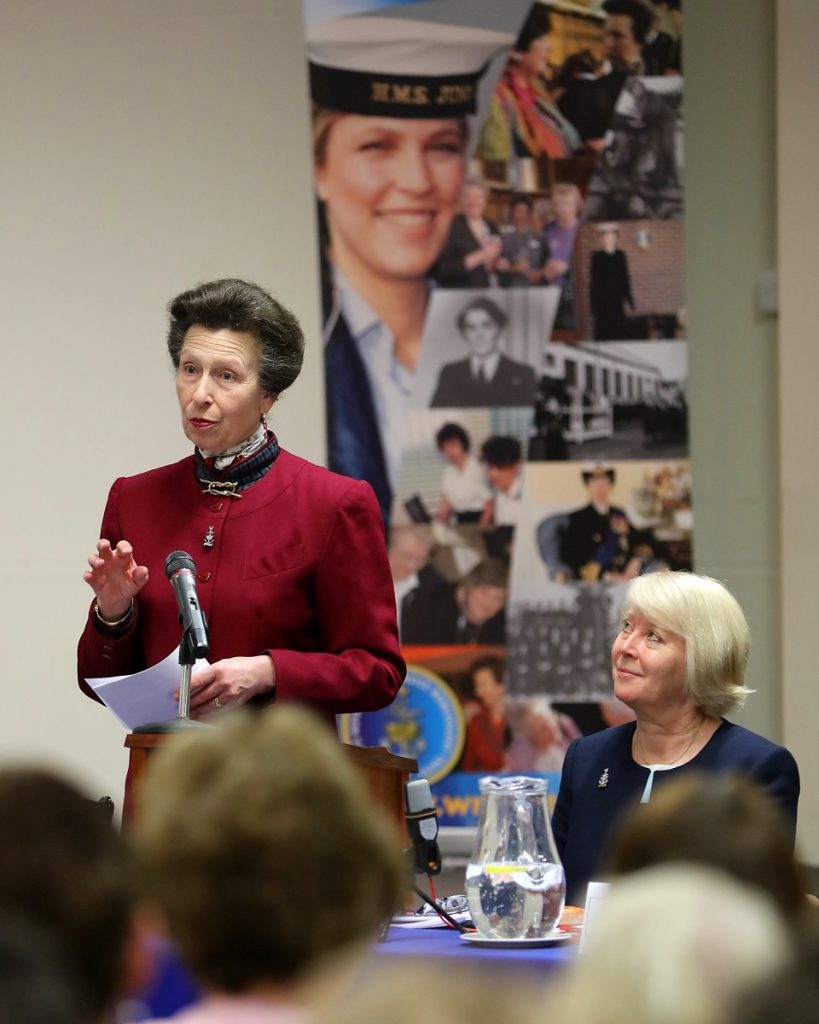
Cdr Crook said that on Sunday 12th March, the first Sunday after the official launch of WRNS100, a group from the Project Team had joined the congregation of St Peter’s Church, Frimley, to commemorate Dame Katharine Furse’s role as the founding Director of the WRNS. After a short ceremony, flowers had been laid on her grave. This visit had been made at the particular request of the late Dame Marion Kettlewell, a former Vice President, who had wished to ensure that Dame Katharine’s inspiration to so many women be recognised in this special year. At this point, Cdr Crook invited Her Royal Highness to address the Honoured Guests and members.
Her Royal Highness opened by saying that it was a pleasure to attend this first occasion of the Trust’s Annual General Meeting being held at the Swordfish Centre, RNAS Yeovilton. She observed that numbers present seemed to prove it a popular choice, giving opportunity to those unable to attend the usual Portsmouth or London venues. She thanked the Yeovil Branch of the Association of Wrens for providing stalwart assistance and also commended the Fleet Air Arm Museum as a scenic attraction to those present who had not yet visited it – the museum having been a popular destination for her own children during their schooldays.
Her Royal Highness said that not long after attending the Trust’s 2016 Annual General Meeting, she had had the pleasure of visiting the Orkney Islands to attend the centenary commemoration for the Battle of Jutland. She said that she was aware that a number of Wrens served in the Orkneys, and observed that the buildings there, let alone the raw weather, would not have been encouraging; although it was clear that their contribution to the operation of the base was significant. She also referred to her visit to the National Museum of the Royal Navy at Portsmouth during March, on International Women’s Day, when she had the privilege of both launching WRNS100 and opening the museum’s exhibition, “From Pioneers to Professionals: Women and the Royal Navy”. She felt that the exhibition widely demonstrated the professionalism and often-underestimated contribution of women in Naval roles, and strongly recommended a visit.
Her Royal Highness pointed out that there would be numerous diverse national and regional commemoration activities taking place across the country – and indeed, overseas. These would provide opportunity for as many former Wrens as possible to mark the occasion and be involved in the celebrations; perhaps encouraging some of those who had lost touch with their service roots to reconnect. Indeed, individuals may well have their memories jogged when driving around the country, if they should come across Eddie Stobart’s “Jenny Wren” and Diamond Trucking Services’ “WRNS100” lorries; Her Royal Highness added that she would ask for a show of hands at the next AGM to see how many had spotted these vehicles! She also said that it was good to know that many of the events, such as the Afternoon Tea Parties at RNAS Culdrose and HMS COLLINGWOOD, and Open Days at Britannia Royal Naval College and HMS RALEIGH, would encourage intermingling of both serving women and the retired.
Her Royal Highness observed that many of those serving in the Royal Navy today would have mothers, aunts or grandmothers who had served in the WRNS, and that the support that the Royal Navy was providing to WRNS100 celebrations provided a timely reminder to all those it touched; not only of how the formation of the WRNS laid the foundations for women serving today, but also the existence of the WRNS Benevolent Trust and the Association of Wrens, who continued to work hand in hand to mutual benefit of their members.
Her Royal Highness said that the Trustees believed that many of those who served in the Second World War did not come to the Trust until they were very desperate indeed, and often not until their Local Authority had become involved. The Trust could only emphasise that if help is sought at an earlier date, then much anxiety can be allayed, and necessary and reassuring support put in place to make their lives a little easier. She reminded those present that with their connections and awareness they were well placed to point people in the right direction, as indeed were the fellow military charities.
Her Royal Highness was aware that the gradual reduction in the number of the Trust’s beneficiaries, as predicted by both the 2010 Actuarial Review and the refresh of this conducted in 2015, continued much as anticipated. However, in 2016 more people had approached the Trust for the first time than in 2015, and thus far in 2017, the number of approaches was on a par with that at the same point last year. She said that it was perceivable that WRNS100 commemorations, as so well promulgated within regular media coverage in all its forms, was increasing public awareness of the Trust.
Her Royal Highness recalled that at the 2012 Annual General Meeting held at the Mansion House in London, she had mentioned that the Wrens’ Facebook Group had over 1,300 members, and that it was proving a particularly successful means of communication. She was pleased to say that today, the Group was flourishing, with 3,800 members who looked out for and supported each other. The WRNS Benevolent Trust now also had its own Facebook page, and over the last 12 months the Trust had seen an increase in the number of enquiries regarding assistance being channelled from both Facebook and direct from its website.
Her Royal Highness said that the work of the Trust remained as important and relevant as ever, and that it was the duty of all to ensure that former Wrens, along with their families and friends, know how they can get help if they are in real need, whether financial, or when they are simply seeking companionship. Effective communication was the key to the ability of the Trust, and its partners within the charitable sector, to meet objectives. She said that each former Wren present was in fact an ambassador who, in normal daily life, could not only remind people how opportunities available today for women in the Royal Navy began with the vision and the determination of the WRNS, but could also get the message across to the wider community of former Wrens, that “your Trust” is here to help. She said that she was aware that some members gave regular talks to the public (for example, at Women’s Institute Meetings); but that it should be remembered that the visiting plumber may be ex-Navy, or may have a relative who was a Wren. Communication was the key, with so much common ground to be regained when just one former Wren engaged with another.
Her Royal Highness concluded by saying that the continued success of the Trust depended upon the many individuals who voluntarily gave their time and expertise; by writing books and articles, giving presentations, manning stands at events around the country, running fundraising activities, and right through to attending one of the Trust’s Grants Committee meetings as an observer. She said that every contribution counted, and that without this support the Trust would not be the success that it was. She reiterated thanks to RNAS Yeovilton and the AOW Yeovil Branch for the polished service involved in hosting the AGM, and looked forward to seeing many faces again.
The Chairman thanked Her Royal Highness for the close interest that she had always taken in the WRNS Benevolent Trust, and for the kind words of her address. She introduced the other people on the platform: Cdr Heather Rimmer RN (Vice Chairman); Mrs Sarah Ayton (General Secretary); and Cdr Liz Walmsley RN (Governor and Honorary Treasurer).
Minutes of the 74th annual general meeting
Cdr Crook reminded members present that the minutes of the last meeting held on 24 May 2016 had been circulated for approval. After asking for their agreement and receiving no objections, the Chairman signed the minutes.
Annual report and statement of accounts
Cdr Crook presented the 75th Annual Report of the WRNS BT on behalf of the Central Committee. She went on to highlight the most significant points.
During 2016, and in response to the gradual reduction in potential beneficiaries, the Grants Committee had trialled meeting every 3 weeks rather than fortnightly, with the option of out-of-committee consideration for urgent cases, to ensure that beneficiaries received prompt consideration and assistance. This arrangement had worked well, and the trial continued during 2017. In 2016 the Trust had assisted 240 beneficiaries, including 15 residing overseas. This showed a small increase from 236 in 2015; however, there was a decrease in the total value of regular and one-off grants provided, down from £281,320 to £275,994.
With the reduction in the number of cases over the years, the Trust’s Grants Administrator now had more time to delve into the background of cases submitted, and was able to offer wider advice to both the applicant and SSAFA caseworkers.
Looking at grants expenditure in more detail, Cdr Crook said that at page 7 of the report it was identified that there had been a small increase in the total value of the Regular General Amenity and Weekly Grants in issue, at £194,284.
With the exception of Regular grants, the next highest spend was again on Medical Aids, at £19,783. The most noticeable increase in expenditure was in the area of Funeral Expenses, where 12 individuals had been provided with assistance, in contrast with 5 in 2016. As reported at the last AGM, although some beneficiaries do plan ahead for their funerals, it was clear that some others fail to make any provision at all, incorrectly expecting that the State would pay, or that their estate or relatives would meet the bill. Unfortunately, those family members left behind were sometimes unable to contribute due to their own financial circumstances, or sadly, in some cases were unwilling to do so. The Trust continued to encourage its members to make provision. The next highest spends were on Household Goods (£10,747) and Household Repairs (£10,207).
Expenditure on Education Grants reflected the support provided in specific accord with the Trust’s Royal Charter, to those who wished to retrain, educationally or professionally, in order to be better able to support themselves and their dependants. An example of this was shown at page 10 of the report.
The number of applicants approaching the Trust for the first time had actually increased, to 49 (11 more than in 2015) and the Trustees continued to monitor the numbers closely to see if there was an identifiable trend – perhaps one linked to the media coverage provided by WRNS100. The overall number of one-off grant applications approved had marginally reduced, to 94 (one down from 2016). It was considered that the effectiveness of the Trust’s pre-Grants Committee screening process had had a positive impact.
Cdr Crook said that those who had attended the last AGM would recall that in recognition of the fact the cost of assistance being requested was increasing at a faster rate than inflation, the Central Committee had approved an increase in the Trust’s maximum one-off grant to £4,000. Cdr Crook said that the Grants Committee viewed every case carefully, and that during 2016 it had only been considered appropriate to use this enhanced flexibility on one occasion; while 3 maximum grants (of £3,000) had been awarded in the preceding year, 2015.
The graph on page 9 depicted the age breakdown of those the Trust had helped over the past year. This showed that the Trust continued to help a significant number of ladies in their 80s and 90s, while some 30% were in their 40s and 50s. Around 45% of those being helped remained under State Pension age, and this figure had remained fairly constant over the last 10 years, despite the increase in the qualifying age.
The Chairman drew attention to one lady, and by default, her husband, whom the Trust had been helping in recent years. This lady, now 80 years old and in increasingly poor health, had been married to a foreign national since the 1960s, when they were both serving in their respective navies. After the tragic loss of their 2 sons in separate incidents, she had returned to the UK 5 years ago to be closer to their only daughter. Her husband, the father, now in his late 70s, followed her to UK shortly after, and the couple now lived in privately rented accommodation. The husband was not entitled to UK benefits, and had only a very small foreign pension as income, so this couple existed on the wife’s State Pension and Pension Credit to the sum guaranteed by the Government for a single State pensioner. The Trust had now supplemented this with a regular Weekly Maintenance Grant, and in addition, funded renewal of the husband’s UK Visa, along with an Immigration Health surcharge understandably imposed by the NHS. Additionally, and with an equal share from The Royal British Legion, the Trust had provided our lady with a disability scooter. She was now in receipt of a State disability benefit, although because her husband was not recognised, he was unable to claim Carer’s Allowance for helping to provide physical support to her.
Cdr Crook said that the Trust remained very grateful for the support provided by SSAFA, the Royal British Legion and others, in identifying potential beneficiaries, and providing the necessary paperwork in what were often complex cases.
In addition to actual grant business, the Trust continued to receive a high number of calls from those seeking support in other, but related ways, and the General and Assistant Secretaries continued to assist individuals and their families, offering advice and signposting to requisite authorities.
Extracts from letters of thanks from beneficiaries and families could be found on pages 9-11 of the report (including from a lady whose need had been highlighted at the 2016 AGM), and inside the back cover.
The Chairman said that the Trustees remained confident that the Trust’s Strategic Plan, based on the refreshed Actuarial Review, continued to be well founded. However, it was clear that financial pressures would continue to impact on local authorities and the level, and kind, of care support that they could provide; including the provision of beds in care homes. The Trust therefore stood ready to ameliorate any impact on its beneficiaries wherever possible.
Cdr Crook said that the Trust continued to work closely alongside the other Naval Charities, sharing outreach opportunities, and it was good to see so many representatives in the audience from organisations which offered support, and helped make the work of the Trust possible. The Trust was most grateful for the support of all those individuals and organisations mentioned on pages 13-14 of the report.
The Chairman said the Trust remained very appreciative of those who remembered the charity in their wills, and details of the many generous Legacies and In Memory Donations received were provided at pages 14-15. Cdr Crook emphasised that these donations made such a difference to the work of the Trust.
The Trust was also extremely grateful to the members of the Association of Wrens for all that they did on its behalf, including fundraising and putting people in touch. Details of the totals raised for the Trust by the Association’s Branches and Informal Groups were at page 16. Cdr Crook said that the 2017 joint-fundraising dinner would be held in the Union Jack Club, London, following the Association of Wrens’ Annual General Meeting on Friday 8th December, while the Carol Service would take place at St Mary le Strand Church at 1330 the following day.
Cdr Crook gave huge thanks to the WRNS BT Trustees, the members of the Central, Grants and Finance Committees, Ambassadors, the General and Assistant Secretaries, and all the members of the Trust who freely gave of their time to help out at events throughout the year. She then called upon Cdr Liz Walmsley, the Honorary Treasurer, to present the Balance Sheet and Statement of Accounts.
Cdr Walmsley started by saying that from a financial perspective, 2016 had turned out well for the Trust. Overall, the accounts showed a net income (after investment gains) of £378,000, and an operating surplus of £62,000 against a planned budget of £254,000. Main sources of income were legacies, dividends and interest from investments, and donations. Looking at each in turn, she advised the following:
(1) Legacy income in 2016 had been very high, totalling £285,000. Five legacies had exceeded £10,000 and two of these were in the region of £80,000. At the end of the year, the Trust had also been notified of further legacies to the value of £6,000, expected to be received during 2017. Without certainty ever being in place, legacy income would clearly fluctuate from year to year, with £210,000 received in 2015, £90,000 in 2014 and £202,000 in 2013. The Trust continued to be extremely grateful for such thoughtful contributions, which, as highlighted by the Patron and the Chairman, enabled the Trust to continue to support former Wrens in real need.
(2) Investments. Dividends from investments were by far the most reliable and constant source of annual income, and provided approximately 52% of monies needed to cover the Trust’s Grants Expenditure. While £149,000 had been received in 2013, £150,000 in 2014 and £145,000 in 2015, this had fallen again in 2016, to £143,000. This reflected continued low interest rates of cash on deposit and the impact of general investment market performance. Conversely, the year-end hike in the stock market resulted in unrealised gains to the investment portfolio of £284,000, and a year-end value of £3,723,000.
(3) Other Sources of Income. These, including donations and fundraising, had amounted to £27,000. This was less than in 2015, when the Trust had received an unusually large In Memoriam donation. It also reflected the fact that fundraising efforts had naturally focused on WRNS100. While no major fundraising occasions had taken place for the direct benefit of the Trust in 2016, it was anticipated that a generous donation would be received at the end of 2017, once the year’s WRNS100 activities had drawn to a close. As in the previous two years, no major external grants were requested in 2016.
On the expenditure side:
(1) Grants to Beneficiaries. Grants made to beneficiaries had fallen by 1.9% to £276,000 in 2016.
(2) Investment Management Costs. These remained static at £24,000.
(3) Other Expenditure. Fundraising costs had reduced in 2016, the Trust not incurring any further legal costs as experienced in 2015 in respect of a complex legacy. Publicity costs had been higher, as the Trust had taken the opportunity to raise its profile in conjunction with WRNS100 events.
Overall, taking into account all assets and liabilities, the Trust had closed the year with a balance sheet figure of £4,094,787 – representing an increase of nearly £378,000 on 2015, while noting that this included the £284,000 unrealised gain on the investment portfolio.
Cdr Walmsley said that the Trust continued to hold sufficient funds to meet the anticipated needs of the charity for 2017, and with no intention to seek external grants, would, if there was a shortfall, start to draw down on investments in accordance with the Strategic Plan, itself based around the predictions of the Actuarial Review.
On behalf of the Trustees, Cdr Walmsley expressed sincere thanks to all the organisations and individuals who had donated to the Trust in any way – particularly remembering those who had left the Trust a legacy in their wills. As always, the Trust was extremely grateful to the Association of Wrens, who continued to support the charity through collection boxes, fundraising within their branches, and manning joint stalls at many events throughout the year. She particularly thanked members of the RNA for their donations to the Trust, and all those who gave in memoriam donations. She also thanked the Finance Committee and the Secretaries for their hard work and support, as well as (in attendance) Mr James New, the Trust’s bank manager (NatWest); Mr Robert Woolley from HPH (Auditors); and Ms Miranda Thompson-Schwab, representing Brewin Dolphin (Investment Managers). This concluded the financial review.
Cdr Crook thanked Cdr Walmsley for her report. This concluded the presentation of the Annual Report.
Adoption of the annual report, balance sheet and statement of accounts
The Chairman asked Lt Cdr Kath Hutton to propose the adoption of the 75th Annual Report, Balance Sheet and Statement of Accounts as audited, for the year ended 31 December 2016. Mrs Barbara Hines seconded the proposal and the resolution was unanimously carried.
Elections
The Chairman asked those eligible to vote (i.e. former Wrens), to approve the list of those nominated for office in 2017/18, as supported by the Central Committee. There was one new nomination for Vice President – Cdr Maggie Cole RN, a continuing and long term supporter of both the Trust and the Association of Wrens. Both Cdre Picton and Mrs Mary Brittan had now completed their tenure as Governors, and two new nominations were identified as Cdr Catherine Jordan and CPO (RNR) Sandra Parkinson, who would bring a wealth of knowledge and experience to the Trust. All of these nominations had been unanimously supported by the Central Committee. Cdr Crook called upon WO1 Paula Price to propose the nominations for the Central Committee and the Vice Presidents, and the motion was seconded by Mrs Alison Gott. Cdr Crook asked for a show of hands from those in the audience who were eligible to vote, and the motion was carried. She added that the Trust was most grateful for all the hard work undertaken by the two departing Governors, and she was very pleased to report that their dedicated support of the Trust would continue, as Cdre Picton would remain in post as Chairman of the Finance Committee, and Mrs Brittan as a member of the Grants Committee.
Re-appointment of auditors
Cdr Crook called upon Mrs Jacqueline Clink to propose the motion to re-appoint the auditors, HPH (as represented at the AGM by Mr Robert Woolley), and this was seconded by Cdr Heather Rimmer. This motion was also carried.
Conclusion
Cdr Crook said that this concluded the formal part of the meeting.
WRNS100 entertainment
Cdr Crook said that at this point there would usually be a guest speaker; however, in this special year there would be something different. She reminded the audience that the new march written to mark WRNS100 had been played on entry, and there would now follow a short film from 2017’s Mountbatten Festival of Music. This featured the Royal Navy’s most important 2017 naval anniversaries: 25 years since women first joined the Royal Marines Band Service, 100 years of the Perisher (Royal Navy Submarine Command) Course; the centenary of the Battle of Gavrelle (which saw the largest losses in Royal Marines history, with 846 killed, wounded or missing); and of course, 100 years since the formation of the WRNS. The film had been put together for the Trust by the Royal Marines Band Service’s production team, and the Trust was very grateful for this support.
On completion of the film there followed the rendition and acting-out of the newly penned Centwrennial Ode by its author, Mrs Ollie Butler, a Governor of the Trust. This impressive offering was extremely well received, and suitably acknowledged in kind by Lt Jane Pizii, delivering the vote of thanks.